The next trillion dollars of on-chain trading volume isn't coming from BTC or ETH. It's coming from RWAs. TradFi moves $30T+ a year in derivatives on stocks, commodities, and currencies. On-chain perps capture less than 0.01% of it.
Closing that gap is the meta-narrative of the next two years of crypto, and every perps platform is racing for it. None of them, not Hyperliquid, not Lighter, not any orderbook, will get there in the next decade.
Every mature financial market runs on two complementary venues: one for price discovery, one for distribution and execution. Crypto has only built the first. The second is what unlocks RWAs at scale.
Here's the problem: every new market on Hyperliquid or Lighter has to bootstrap its own crypto-native liquidity from scratch. Meanwhile, the TradFi players who already power those underlyings run multi-trillion-dollar books built over decades. Rebuilding it all on-chain, ticker by ticker, isn't a strategy for scaling global finance. It's a massive mistake and misallocation of capital.
The shortcomings are already visible. In March 2026, Castle Labs benchmarked the most-developed on-chain oil perp (a Hyperliquid HIP-3 market) against CME's WTI April contract:
- 1% as deep. Depth within ±2 bp of mid: CME $19M, Hyperliquid $152k.
- 20x more slippage. Slippage on a $1M trade: CME 0.79 bp, Hyperliquid 15.4 bp.
- When geopolitical news moved oil 11% overnight while CME was closed, the HIP-3 market blew out to 160 bp slippage on a $1M trade, 200x the CME baseline.
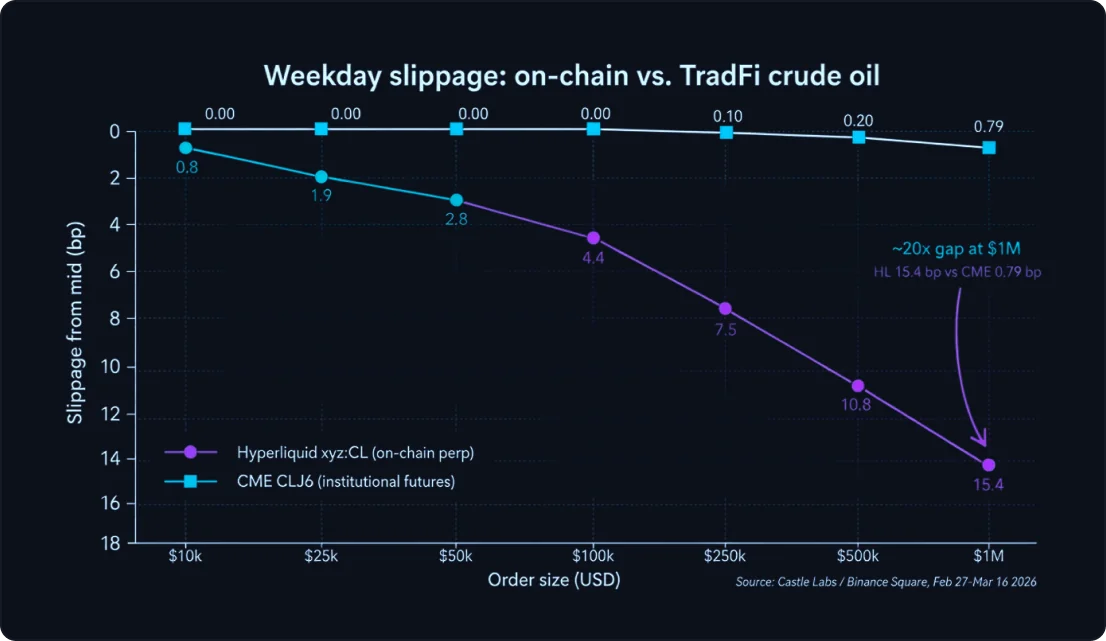
This is the asset with the longest time to mature and the most retail interest in March. The single-name long tail is materially worse.
Lighter's response in April 2026: a $250k/week subsidy program to rent depth in oil, gold, silver, and a few single names. The program itself proves the point. On-chain RWA depth doesn't form organically at TradFi-competitive scale. It has to be paid for, market by market, every time.
Every CLOB platform is sucking RWA liquidity through a straw: tiny pools of depth, one market at a time, while the multi-trillion-dollar TradFi ocean sits right next to it. The brokerage model mainlines it directly.
The Brokerage Model
CLOBs do what they're built for: price discovery on liquid markets. Hyperliquid will keep winning that game. But "perps on everything" is a different problem, and TradFi solved it decades ago with a different primitive.
More than half of global trading volume doesn't go through exchanges. It goes through brokerages. Brokerages don't bootstrap liquidity per market. They aggregate it from the dealers who already make the underlying, internalize offsetting flow, route externally when it doesn't, and earn the spread instead of charging fees.
By plugging into the venues where global liquidity already lives, the cold-start problem disappears. When retail wants a niche tech stock or a trending commodity, a brokerage doesn't rent MM balance sheet, it routes to the deepest existing venue. Bootstrapping liquidity becomes an integration problem. New markets ship at the speed of software.
Variational: Bringing TradFi Liquidity On-Chain
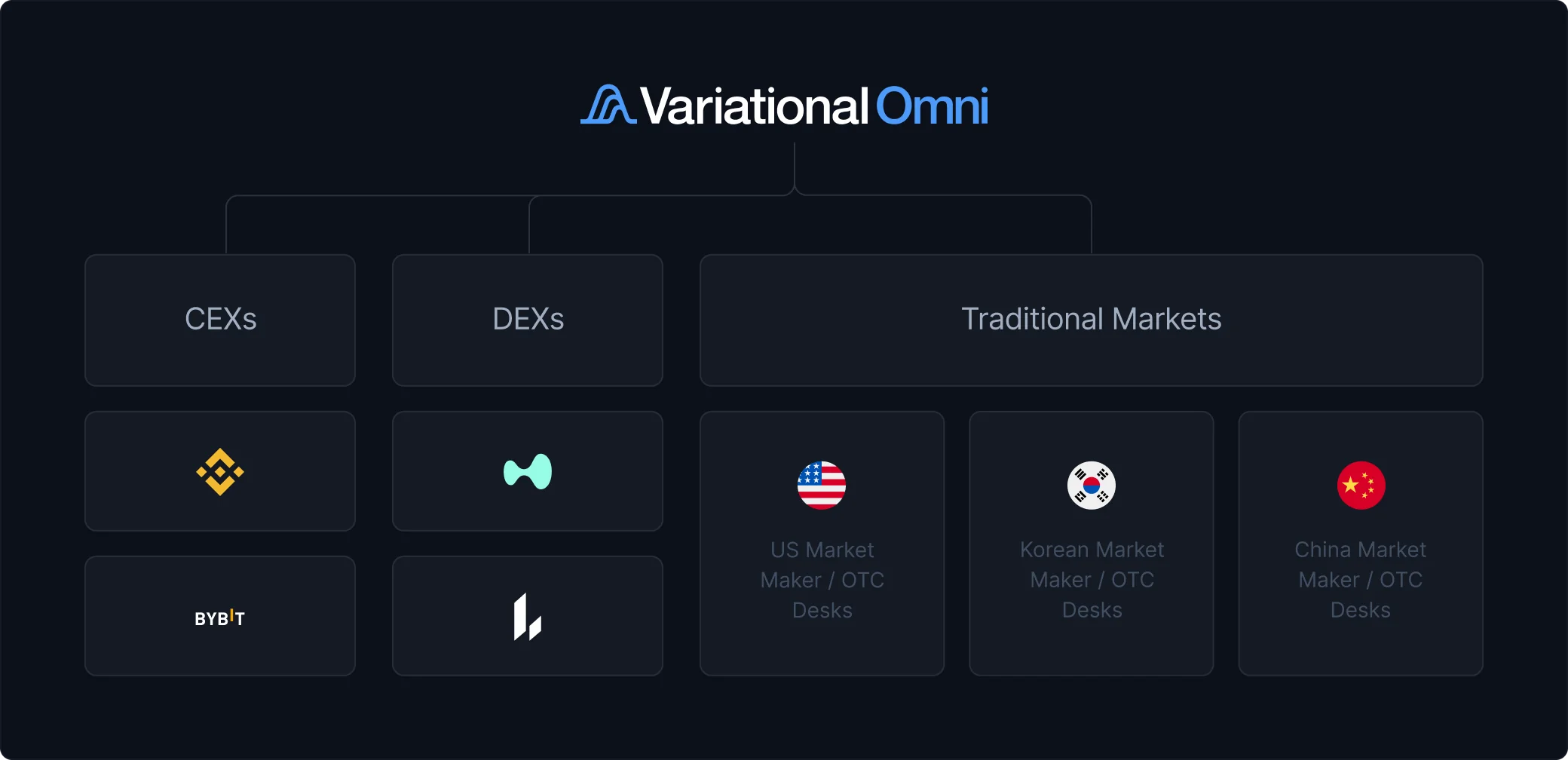
We're bringing TradFi liquidity on-chain with a brokerage-like model: margin lives in smart contracts, settlement is done via stablecoins, and liquidity is aggregated via RFQ.
Three Goals:
- Universal coverage: one account, every market. Starting from 450+ crypto markets, phasing in RWAs such as stocks, ETFs, commodities, FX, and more as the dealer network grows.
- TradFi depth, no cold start. Variational integrates liquidity from the dealers powering the underlying markets, instead of paying to rebuild depth from scratch.
- Spread shared, not extracted. Margins redistributed through zero trading fees, rebates, rewards, and direct ownership in the platform's Liquidity Provider.
Three Phases:
- Phase 1: Testing The Pipes (<1 month out). First RWA perp listings: US500, oil, gold, silver, indices. Single USDC balance, cross-margined with crypto perps, up to 50x leverage, 0% fees, and 24/7 trading. Backed by CEX and DEX liquidity at launch, using the same infra that powers our 450+ crypto markets with leading depth.
- Phase 2: TradFi On-Chain (~1 month out). 23/5 CFDs as an entirely new product class, routed through tier-1 non-bank MMs under already-signed agreements. Nearly flat funding, hundreds of single-name equities, indices, FX pairs, and commodities. Isolated margin alongside the cross-margined 24/7 menu.
- Phase 3: Universal Coverage (Q3 & Beyond). Multi-dealer, 24/7, cross-margined. Partnerships across major Asian jurisdictions are already in active commercial conversation. Includes Korean and Japanese stocks and FX, Hong Kong and Australian markets, and specialized product types (prediction markets, expiring products). This is when the perps on everything vision is realized.
By the time Phase 3 ships, Variational is something no platform has ever combined: the breadth of a global brokerage, the cross-margin engine of a prime-brokerage account, and instant on-chain settlement only crypto can provide. One account. Thousands of markets. Every region, every asset class. TradFi-grade execution on all.
By 2027, RWA perps will be the largest contract class on-chain (bigger than BTC and ETH combined). Most of that volume will live in markets that don't exist as on-chain orderbooks today. The venue that wins them will connect to TradFi like a brokerage.
This has been the Variational Vision since day one. Phase 1 of our RWA rollout launches in May.


 Discord
 X/Twitter
 LinkedIn